Category: Accounting

  • Multinational Considerations and Data Analytics

    Sky Armour Industries manufactures high-grade aluminum luggage made from recycled metal. The company operates two divisions: metal recycling and luggage fabrication. Each division operates as a decentralized entity. The metal recycling division is free to sell sheet aluminum to outside buyers, and the luggage fabrication division is free to purchase recycled sheet aluminum from other sources. Currently, however, the recycling division sells all of its output to the fabrication division, and the fabrication division does not purchase materials from any outside suppliers.

    Aluminum is transferred from the recycling division to the fabrication division at 110% of full cost. The recycling division purchases recyclable aluminum for $0.50 per pound. The divisions other variable costs equal $2.80 per pound, and fixed costs at a monthly production level of 50,000 pounds are $1.50 per pound. During the most recent month, 50,000 pounds of aluminum were transferred between the two divisions. The recycling divisions capacity is 70,000 pounds.

    Due to increased demand, the fabrication division expects to use 60,000 pounds of aluminum next month. Metalife Corporation has offered to sell 10,000 pounds of recycled aluminum next month to the fabrication division for $5.00 per pound.

    • Calculate the transfer price during the most recent month per pound of recycled aluminum.
    • Assuming that each division is considered a profit center, would the fabrication manager choose to purchase 10,000 pounds next month from Metalife?
    • Is the purchase in the best interest of Sky Armour Industries? Show your calculations.
    • What is the cause of this goal incongruence?

    The fabrication division manager suggests that $5.00 is now the market price for recycled sheet aluminum and that this should be the new transfer price. Sky Armour Industries corporate management tends to agree. The metal recycling manager is suspicious. Metalifes prices have always been considerably higher than $5.00 per pound.

    Why the sudden price cut? After further investigation by the recycling division manager, it is revealed that the $5.00 per pound price was a one-time-only offer made to the fabrication division due to excess inventory at Metalife. Future orders would be priced at $5.50 per pound.

    • Elaborate on the validity of the $5.00 per pound market price and the ethics of the fabrication manager.
    • Would changing the transfer price to $5.00 matter to Sky Armour Industries?
  • Activity-Based Costing

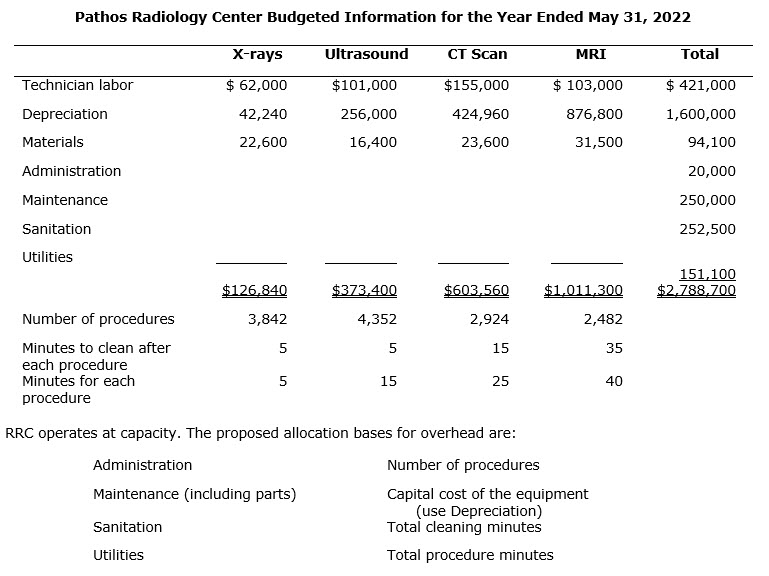
    Pathos Radiology Center (PRC) performs X-rays, ultrasounds, computer tomography (CT) scans, and magnetic resonance imaging (MRI). PRC has developed a reputation as a top radiology center in the state. It has achieved this status because it constantly re-examines its processes and procedures. It has been using a single, facility wide overhead allocation rate. The Vice President of Finance believes that PRC can make better process improvements if it uses more disaggregated cost information. She says, We have state-of-the-art medical imaging technology. Cant we have state-of-the-art accounting technology?

    Table: Pathos Radiology Center Budgeted Information for the Year Ended May 31, 2022

    Table with six columns and eleven rows. Header columns: X-rays, Ultrasound, CT Scan, MRI, Total.

    • Calculate the budgeted cost per service for X-rays, ultrasounds, CT scans, and MRI using direct technician labor costs as the allocation basis.
    • Calculate the budgeted cost per service of X-rays, ultrasounds, CT scans, and MRI if PRC allocated overhead costs using activity-based costing.
    • Evaluate the differences between the 2 costing models, and assess the value of activity-based costing for management profitability analysis and decision making.
    • Explain how the disaggregation of information could be helpful to PRCs intention to continuously improve its services.

  • Balanced Score Card and Cost Allocations

    The CK&M Company manufactures a robotic vacuum called the Robo2000. The company sells the vacuum to discount stores throughout the country. The Robo2000 is a basic robotic vacuum with a remote and is significantly less expensive than the robotic vacuum that requires a smartphone and app offered by the competitor, Stone Manufacturing. Furthermore, CK&M has experienced production problems that have resulted in significant rework costs. Stones model has an excellent reputation for quality.

    • Is CK&Ms current strategy that of product differentiation or cost leadership?
    • What about the strategy of Stone Manufacturing?

    CK&M would like to improve quality and decrease costs by improving processes and training workers to reduce rework. CK&Ms managers believe that increased quality will increase sales.

    • Develop an appropriate strategy to achieve this goal.
    • For each of the 4 perspectives, propose criteria that you would include in a balanced scorecard for CK&M.

    Please submit your assignment.

  • Cost-Volume-Profit

    Forever Pure produces two types of water filters. One attaches to the faucet and cleans all water that passes through the faucet. The other is a pitcher-cum-filter that only purifies water meant for drinking.

    The unit that attaches to the faucet is sold for $72 and has variable costs of $20.

    The pitcher-cum-filter sells for $88 and has variable costs of $16.

    Forever Pure sells two faucet models for every three pitchers sold. Fixed costs equal $960,000.

    • What is the break-even point in unit sales and dollars for each type of filter at the current sales mix?

    Forever Pure is considering buying new production equipment. The new equipment will increase fixed cost by $166,400 per year and will decrease the variable cost of the faucet and the pitcher units by $4 and $8, respectively.

    • Assuming the same sales mix, how many of each type of filter does Forever Pure need to sell to break even?
    • Assuming the same sales mix, at what total sales level would Forever Pure be indifferent between using the old equipment and buying the new production equipment?
    • If total sales are expected to be 23,000 units, should Forever Pure buy the new production equipment?
    • Assess lessons learned concerning cost-volume-profit analysis and decision making.
  • Capital Budgeting

    Markers Tattoo Studio wants to buy new laser therapy equipment. This new equipment would cost $300,000 to purchase and $20,000 to install. Markers estimates that this new equipment would yield incremental margins of $98,000 annually due to new client services. It would require incremental cash maintenance costs of $10,000 annually. Markers expects the life of this equipment to be 5 years. They estimate a terminal disposal value of $20,000.

    Markers has a 25% income tax rate and depreciates assets on a straight-line basis (to terminal value) for tax purposes. The required rate of return on investments is 10%.

    • Determine the expected increase in annual net income from investing in the new equipment.
    • Calculate the accrual accounting rate of return based on average investment.
    • Summarize whether the new equipment is worth investing in from a net present value (NPV) standpoint.

    Suppose that the tax authorities are willing to let Markers depreciate the new equipment down to zero over its useful life. If Markers plans to liquidate the equipment in 5 years, should it take this option? Quantify the impact of this choice on the NPV of the new equipment.

  • ACCT105 D005 Project Milestone 1

    Instructions

    Associated CO & LO:

    • CO-2: Apply the accounting cycle.
      • LO-2.1: Using the underlying assumptions or concepts, analyze business transactions and determine their effects on items in the financial statements.
      • L0 2.2: Analyze financial information and prepare journal entries.

    Assignment Instruction:

    • Complete requirements 1 through 3 of Jane’s Skateboards for the first milestone of the course project. You have the option of using either the T-Accounts tab to post journal entries or the General Ledger tab.
    • You will use the Excel Project Template for Jane’s Skateboards attached below.
    • DO NOT change the Excel template drop-down menus or formulas that are already in the template.
    • You should watch the videos in the Content tab above, under Week 2, to assist you in preparing this Assignment.
    • Save your file as “LastnameFirstinitial-ACCT105-M1.”
    • Submit your work by midnight ET on Day 7 (Sunday).
    • **NOTE: Please make sure you review the instructions in the Excel template so you do not miss any requirements.
    • Again, DO NOT change the Excel template format, drop-down menus, or formulas that are already in the template.

    Assignment Resources & Supports

    Submission Instructions:

    • Submit the completed Excel Workbook for Janes Skateboards parts 1, 2, and 3.
    • The Assignment is due on Sunday of week 2.

    Assignment Rubric Name:

    Assignment File: Janes Skateboards.

  • Foreign Acquisition With Goodwill Proposal

    Competencies In this project, you will demonstrate your mastery of the following competencies: Analyze the governing rules, regulations, and ethical standards and their application to an organizations strategic goals Develop operational strategies to further strategic goals based on financial and operational data Scenario You are working as a senior accountant for Penman Incorporated, an American company following the Control Objectives for Information and Related Technologies (COBIT 5) framework, and your exceptional performance has caught the attention of the chief executive officer (CEO). The CEO has personally requested you to work on a project that involves expanding the companys operations to Australia. The CEO believes in your skills and thinks this project can demonstrate your potential to become the Australia companys chief financial officer (CFO). The company has been doing well, especially in its recent expansion into Western Europe over the last three years. Now, the CEO wants you to consider various aspects of this expansion project, such as accounting, auditing, internal controls, legal requirements, and environmental, social, and governance (ESG) factors. To make this expansion happen, youll need to come up with detailed plans and strategies. These plans should include not only financial information but also nonfinancial data that will help the companys board of directors decide whether to approve the project. One specific option the company is thinking about is acquiring another company called Square Ranching Company. Youll also have access to Square Ranching Companys financial information for your evaluation. Directions For this project, you will use the resource in the Supporting Materials section along with your prior knowledge to create a strategic plan proposal for the board of directors. This proposal will include an analysis of laws and ethical standards in the organizations strategic goals, and it will also contain developed operational strategies to further strategic goals based on information provided in the Supporting Materials section below. Specifically, you must address the following rubric criteria: Part One: Analysis Determine if the acquiring organizations strategic goal complies with governing rules, regulations, and ethical standards by examining its internal control structure within an accounting information system. Evaluate how accounting guidelines affect the organizations strategic goals. Determine conflicts of interest with this organizational acquisition. Evaluate the sustainability initiatives across the ESG regulatory landscape in both countries by recalibrating the risk. Part Two: Operational Strategies Evaluate the organizations short- and long-term goals. Consider the following: How an organization measures success or failure of goal achievement Differentiate between the organizations relevant and irrelevant financial data. Differentiate between the organizations relevant and irrelevant operational data. Identify what financial and nonfinancial information is pertinent to the organizations strategic goals that impact foreign currency financial statements on the organizations financial performance with foreign acquisitions. Create an operational strategy with minimal to no impact on the organizations risk tolerance. Identify important steps of operational strategy to monitor benchmarks for long-term success. What to Submit To complete this project, you must submit the following: Strategic Plan Proposal Submit a 3- to 4-page Word document with 12-point Times New Roman font, double spacing, and one-inch margins. This assignment should include references cited according to APA style. Consult the Shapiro Library APA Style Guide for more information on citations. Supporting Materials The following resource supports your work on the project:

    Attached Files (PDF/DOCX): ACC 740 Foreign Acquisition With Goodwill 3 copy.docx

    Note: Content extraction from these files is restricted, please review them manually.

  • chapter 1

    Today we’re diving into the fundamental question that will shape your entire accounting career: What does it mean to act ethically as an accountant?

    Let me start with a story that might surprise you. Betty Vinson was considered a genuinely good person by everyone who knew her. She had strong moral values and never imagined she’d be involved in fraud. Yet she became a key figure in one of the largest accounting scandals in history. How does this happen?

    This brings us to the concept of ethical blind spots – the gap between who we want to be and who we actually are when faced with pressure. Lets explore how to recognize these blind spots and build the ethical foundation you’ll need throughout your career.

    First, let’s establish our vocabulary. These three terms are often confused:

    • Ethics (from Greek “ethikos” meaning character) deals with standards of right and wrong – how people ought to act
    • Morals (from Latin “moralis”) deals with manners and character – your personal beliefs about right and wrong
    • Values are the fundamental beliefs that guide your attitudes and actions

    Think of it this way: Your values inform your morals, which guide your ethical decisions.

    For accountants, integrity sits at the center of all three. Integrity means acting on principle, having the strength of your convictions, and being reliable. It traces back to ancient Greek philosophy and is absolutely essential in our profession. Why? Because without integrity, the entire financial system loses credibility.

    Your ethical foundation rests on six pillars. Let me walk you through them quickly:

    1. Trustworthiness – This includes honesty, integrity, reliability, and loyalty. In accounting, if stakeholders can’t trust your work, you’ve lost everything.
    2. Respect – Treating every individual with dignity. Remember the Golden Rule appears in virtually every major religion for good reason.
    3. Responsibility – The ability to reflect on alternatives and carry out moral action diligently.
    4. Fairness – Treating others equally and impartially, without bias.
    5. Caring – Having empathy and understanding others’ perspectives. This is crucial for ethical decision-making.
    6. Citizenship – Recognizing your obligations to the broader community and public interest.

    One important note about loyalty: While loyalty is valuable, it should never take precedence over other ethical values. Your primary loyalty as an accountant is to the public interest, not to any individual client or employer.

    Now let’s explore three major moral philosophies that will help you make ethical decisions:

    Teleology focuses on consequences. The most common form is utilitarianism – “the greatest good for the greatest number.” When you’re weighing the impacts of a financial reporting decision on all stakeholders, you’re thinking like a utilitarian.

    Deontology focuses on duties and rules, regardless of consequences. Kant’s categorical imperative tells us to act only according to principles we’d want everyone to follow. In accounting, this means following professional standards even when it might be inconvenient.

    Virtue Ethics focuses on character. What would a person of good character do? This approach asks not “What rule should I follow?” but “What kind of person should I be?”

    Here’s the key: You don’t have to choose just one philosophy. The strongest ethical reasoning often combines all three approaches.

    As future CPAs, you’ll be bound by the AICPA Code of Professional Conduct. The code has two main parts:

    Principles (aspirational):

    • Responsibilities to exercise professional judgment
    • Public Interest – your primary obligation
    • Integrity in all professional activities
    • Objectivity and Independence
    • Due Care in service performance
    • Proper Scope of Services

    Rules (enforceable): These are specific applications of the principles that you must follow or face disciplinary action.

    Remember: The code represents minimum standards. Ethical accountants often go beyond what’s merely required.

    Let’s apply this to a real scenario. Imagine you’re working for a company seeking a $10 million bank loan. Your CEO wants to record $200,000 in revenue for a sale that won’t actually ship until after year-end. The CEO says, “Be a team player here.”

    How do you analyze this ethically?

    • Utilitarianism: Who benefits? Who’s harmed? Recording premature revenue misleads lenders and investors.
    • Deontology: Revenue recognition standards exist for good reason. Following rules protects the system.
    • Virtue Ethics: A person of integrity doesn’t manipulate financial statements.
    • AICPA Code: This violates your duty to the public interest and your obligation to provide accurate information.

    The answer is clear: You cannot record this revenue. But what if your job is threatened?

    This brings us to moral courage – perhaps the most important concept we’ll discuss. Moral courage means:

    • Acting for moral reasons, not convenience
    • Standing up for your convictions
    • Putting others’ interests ahead of your own when ethics demand it

    Your reputation takes years to build but can be destroyed in moments. The accounting profession exists to serve the public interest. When you become a CPA, you’re accepting a social contract to put that public interest first.

    Here’s my challenge to you: Start building your ethical reflexes now. Practice recognizing ethical dilemmas in small situations – group projects, part-time jobs, everyday interactions. The pattern of judgments you make spontaneously under pressure is the best indicator of your moral compass.

    Remember Betty Vinson’s story. Good people can make terrible choices when they lose sight of their ethical foundations. But with strong principles, clear reasoning, and moral courage, you can be the accountant the public trusts and deserves.

    Case 1-1 Operation Varsity Blues

    What motivates a parent to bribe key people to get their kid admitted to a prestigious university? That is the ethical question of Operation Varsity Blues.

    In March 2019, the story broke of an alarming fraudulent scheme by parents to pay off middleman, William Rick Singer, and athletic coaches to give favored treatment to the children of rich and well-connected people.

    Singer, CEO of a college admissions prep company, The Key, took in large amounts of money and laundered them as contributions to a foundation he controlled, Key Worldwide Foundation, which only pretended to help underprivileged students. Using Singers connections, the parents bribed coaches and administrators at some of the most prestigious institutions in the United States.

    Singer helped parents craft fake documentation to allow students to be admitted as recruited athletes even though they never participated in a sport, and he developed an elaborate system to help students cheat on their college entrance exams. He then paid coaches and administrators to look the other way.

    Singer pled guilty to four felony counts, admitting he accepted some $25 million in bribes to rig the admissions process in what he described as a “side door” into college.

    The Department of Justice charged 55 parents, coaches, and administrators with fraud that enabled children of wealthy parents to gain admission to colleges they were not qualified to attend. These included Georgetown, Stanford, UCLA, USC, and the University of Texas at Austin.

    When the story first broke all attention was on two Hollywood actresses Lori Laughlin and Felicity Huffman. At her sentencing, Huffman was very contrite saying I am in full acceptance of my guiltdeep regret and shame. She also said her daughter had no idea of the scheme. She was sentenced to two weeks in prison.

    Laughlin was convicted of conspiracy to commit wire and mail fraud. She was sentenced to 2 months in prison, a $150,000 fine, 2 years of supervised released, and 100 hours of community service.

    Laughlins husband, Giannulli, was convicted of paying $500,000 in bribes to facilitate his childrens acceptance to USC. He earlier had pleaded guilty to conspiracy to commit wire and mail fraud.

    In another case, California investor Todd Blake and his wife, Diane, pled guilty admitting they paid $250,000 to get their daughter into the University of Southern California as a purported volleyball recruit even though she didnt play volleyball in any organized way.

    At USC, athletic director Donna Heinel and mens and womens water polo coach Jovan Vavic were fired after allegedly receiving bribes totaling more than $1.3 million and $250,000, respectively, to help parents take advantage of relaxed admissions standards for athletes at USC even though their kids were not being recruited as athletes.

    In one audacious scheme, Singer bribed test administrators in Houston and Los Angeles to allow Mark Riddell, a very bright individual, to secretly take the ACT and SAT tests in place of the children of the parents that Singer represented. He scored 35 out of 36 on the ACT, which put him in about the 99th percentile of ACT takers.

    Some of the students were expelled. Others had their admissions revoked. Some of the coaches have been fired. They faced chargesathletic coaches who were involved in misrepresenting people as being recruits.

    Even though Singer was the mastermind of the college admissions scandal, he was ordered to serve only 3.5 years in federal prison, although it was the longest sentence in a case that has rattled Americas higher education system.

    Singer pleaded guilty to racketeering conspiracy, money laundering conspiracy, conspiracy to defraud the US and obstruction of justice in March 2019. He cooperated with the governments investigation in the months prior to the public announcement of the case and in the years since. Perhaps this is why his sentence was relatively light.

    In federal court in Boston on January 4, 2023, Singer apologized for his actions and said his morals took a backseat to winning and keeping score. I lost my ethical values and have so much regret. To be frank, Im ashamed of myself, Singer said.

    Questions

    1. In about 300 words, examine the behavior of the parents from the perspective of moral relativism. Is it fair to say the parents believed the rules should not apply to them? Explain.
    2. In about 300 words, evaluate the actions of the parents using teleology, deontology, and justice.
    3. In about 300 words, do you believe the punishment fit the crime in the case of Rick Singer? Do you think he was contrite? What is your takeaway from Operation Varsity Blues?

    Case 1-5 Lottery Bonanza

    Sam and John have been friends for 20 years. They met in college and worked together for 10 of the 20 years. During that time, each made a promise that if they won a lottery they would share the winnings 50:50. Even though they drifted apart over the years, they had a bond of friendship that neither forgot.

    One day Sam plays the Lotto and wins $2 million. He remembers the agreement with John. Sam tells his wife he will call John and give him the good news that he will get $1 million from their good fortune. His wife is astonished. She reminds Sam that they have thousands of dollars of unpaid bills and $2 million would more than cover them. She tells Sam to forget about contacting John, with whom they havent spoke for three years, and keep all the winnings.

    Sam is trying to decide what to do. He would like to share his good fortune with John but doesnt want to upset his wife. Paying off the bills will bring them peace of mind.

    Questions

    Drawing upon the concepts and ethical theories presented in the chapter respond to the following questions in about 900 words.

    1. Assume you are in Sams position. What would you do and why?
    2. Would your decision change if any of the following situations existed? Each question is independent of the others.
    3. You have grown apart from John over the years and havent spoken to him for two years.
    4. Your child has a medical condition that requires surgery and your insurance carrier has refused to cover the costs.
    5. You won $20 million in the lottery not $2 million.

    Find something that interests you in Chapter 1 and write a 1 page word document discussion/reflection about it.

    • Maybe something that happened in your personal/professional life that you can link to the chapter.
    • Maybe you don’t agree with something in the chapter, and you want to explain why.
    • Maybe there is a new approach to an ethical situations that you learned from the reading that you can describe.

    This is your own personal reflection, so it should be completely done with your own thoughts and ideas. This exercise is intended to help you grow and learn as a professional. It is not meant to copy/paste verbiage from the book or anywhere else.
  • BUS 220 Accounting Final Assessment

    Attached Files (PDF/DOCX): BUS 220 Final Assessement Guide.pdf

    Note: Content extraction from these files is restricted, please review them manually.

  • Asset and liability accounts.

    If a service company purchases office equipment worth Rp10,000,000 on credit, how does this transaction affect the balance positions in the company’s basic accounting equation, specifically regarding the asset and liability accounts?