Can you please answer those following student and responds to exam questions including example . Graf – Week 6 Discussion – Initial Post Pathophysiological basis of hyperkalemia Hyperkalemia is a disorder characterized by elevated serum potassium levels, generally greater than 5.05.5 mEq/L. Potassium plays a critical role in maintaining normal neuromuscular and cardiac cell membrane potentials. Under normal physiology, the kidneys regulate potassium balance through renal excretion, largely mediated by aldosterone. In hyperkalemia, this regulatory mechanism fails due to impaired renal excretion, decreased aldosterone activity, or a shift of potassium from the intracellular to the extracellular space. Elevated extracellular potassium reduces the resting membrane potential, making cells, particularly cardiac myocytes, more excitable initially and then unable to properly depolarize, which significantly increases the risk of life threatening cardiac arrhythmias. Common clinical manifestations and comorbidities Clinical manifestations of hyperkalemia range from asymptomatic findings to severe, life threatening complications. Mild cases may present with nonspecific symptoms such as fatigue, nausea, vomiting, or diarrhea. As potassium levels rise, patients may develop muscle weakness, paresthesias, flaccid paralysis, and characteristic cardiac conduction abnormalities, including peaked T waves, widened QRS complexes, and ventricular arrhythmias. Hyperkalemia is frequently associated with comorbidities such as chronic kidney disease, heart failure, diabetes mellitus, and adrenal insufficiency. These conditions either impair potassium excretion or alter potassium distribution, placing patients at higher risk for recurrent or severe hyperkalemia. Causes and modifiable risk factors The causes of hyperkalemia can be grouped into impaired renal excretion, excessive potassium intake, and redistribution of potassium from cells into the bloodstream. Common causes include acute or chronic kidney disease, metabolic acidosis, insulin deficiency, tissue breakdown (such as rhabdomyolysis or trauma), and medications that reduce potassium elimination. Modifiable risk factors include dietary intake of potassium, use of potassium sparing diuretics, ACE inhibitors, angiotensin receptor blockers, and nonsteroidal anti-inflammatory drugs. Poorly controlled diabetes, dehydration, and inadequate monitoring of renal function further increase risk. Addressing these modifiable factors through medication adjustments, dietary counseling, hydration, and disease management can significantly reduce the likelihood of hyperkalemia. Role of non-modifiable risk factors (age, gender, race) Non-modifiable risk factors also contribute to the development of hyperkalemia. Advanced age is a major risk factor due to the natural decline in renal function over time and the increased prevalence of chronic diseases such as kidney disease and heart failure in older adults. Age related polypharmacy further compounds this risk. Some evidence suggests males may have a slightly higher risk of hyperkalemia, possibly related to differences in muscle mass, comorbidity burden, or medication use, although findings are inconsistent. Racial differences have also been observed, with some studies indicating variations in potassium handling and kidney disease progression across populations. While these factors cannot be changed, recognizing them is essential for early identification, monitoring, and prevention of complications related to hyperkalemia. Exam Question: Which of the following ECG findings is most commonly associated with hyperkalemia? A. Prolonged QT interval B. Peaked T waves C. ST-segment elevation D. Narrowed QRS complex References: Cleveland Clinic. (2023). Hyperkalemia and potassium levels. Cleveland Clinic. Simon, L. V., Farrell, M. W., & Hashmi, M. F. (2023). Hyperkalemia. National Library of Medicine; StatPearls Publishing. Students 2 Lomando, Week 6, Initial Discussion Explain the pathophysiological basis for the disease – Potassium Imbalance Potassium is an essential electrolyte that helps regulate nerve signaling, muscle contraction, and heart rhythm. It is obtained through the diet and is primarily regulated by the kidneys, which excrete excess amounts in the urine. As long as kidney function is normal, dietary potassium intake usually does not cause significant problems. Imbalances of potassium typically occur when potassium intake is too low due to anorexia, when kidney function is impaired, or when excessive urinary loss occurs, such as during diuresis (Passing Pathophysiology, 2023) Acidbase balance plays an important role in regulating potassium movement between the intracellular and extracellular spaces. Because potassium is the primary intracellular cation, shifts in hydrogen ion concentration affect where potassium is located (Passing Pathophysiology, 2023). During acidosis, hydrogen ions move into cells, causing potassium to shift out into the bloodstream and raise serum potassium levels (hyperkalemia). In contrast, during alkalosis, hydrogen ions leave cells, leading potassium to move into cells and lower serum potassium levels (hypokalemia) (Passing Pathophysiology, 2023). Potassium is essential for maintaining intracellular fluid balance, normal cellular metabolism, nerve conduction, and muscle contraction, making the regulation of this electrolyte critical for overall cellular and cardiovascular function (Kim et al., 2023). Describe the common clinical manifestations and comorbidities associated with the disease of your choice. Potassium imbalances commonly present with symptoms related to disrupted neuromuscular and cardiac electrical activity (Kim et al., 2023). Hypokalemia is frequently associated with muscle weakness, fatigue, cramps, constipation, and cardiac arrhythmias. Hyperkalemia often manifests as paresthesia, progressive muscle weakness, and potentially life-threatening cardiac conduction abnormalities, including ventricular arrhythmias and cardiac arrest. These electrolyte disturbances are strongly linked to underlying chronic kidney disease, heart failure, diabetes mellitus, and medication use affecting the reninangiotensinaldosterone system, all of which impair potassium regulation or excretion. The presence of these comorbidities significantly increases morbidity and mortality risk, highlighting the importance of early recognition and monitoring in vulnerable populations (Kim et al., 2023 Discuss the causes and modifiable risk factors of the disease you choose. Hypokalemia and hyperkalemia occur when normal regulation of potassium intake, distribution, or excretion is disrupted. Hypokalemia is normally caused by excessive gastrointestinal or renal potassium loss, diuretic use, intracellular potassium shifts, or inadequate intake, whereas hyperkalemia is most often caused by impaired renal excretion, particularly in individuals with chronic kidney disease, diabetes, or those taking medications that affect the reninangiotensinaldosterone system (Kim et al., 2023). Several modifiable risk factors influence potassium levels, including inappropriate medication dosing or lack of laboratory monitoring, excessive or insufficient dietary potassium intake with renal impairment, dehydration, and unmanaged conditions such as uncontrolled diabetes or worsening kidney disease. Preventive strategies such as medication review, routine electrolyte monitoring, patient education on diet and hydration, and improved management of chronic illness can significantly reduce the risk of serious complications associated with abnormal potassium levels (Kim et al., 2023). Discuss the role of non-modifiable risk factors such as gender, race, and age-related factors of this disease. Several non-modifiable risk factors influence the likelihood of developing potassium imbalances. Evidence suggests that male sex, non-Black race, and older age are associated with a higher risk of potassium abnormities. Advancing age is particularly important because it is commonly accompanied by declining renal function, which reduces the bodys ability to regulate potassium balance effectively (Hunter & Bailey, 2019). Question: Which symptom should the nurse recognize as most concerning in a patient with a potassium imbalance? A. Headache B. Muscle weakness C. Cardiac rhythm changes D. Increased thirst
Category: uncategorised
-
NN
Business priorities, secure development, and training & awareness
Read – Chapters 5, 7
- What can influence the effectiveness of a training program?
- What are some of the various ways to implement an awareness program?
- Describe the two overriding benefits of awareness, training, and education.
- What is a performance measure in the context of information security management?
- What types of measures are used for information security management measurement programs?
- What factors are critical to the success of an information security performance program?
Textbook: Whitman and Mattord, Management of Information Security, Sixth Edition, ISBN-13: 978- 1337405713, ISBN-10: 133740571X, Cengage Learning, 2019.
-
re 194 ass 3
Unit 3: Real Estate and Its Appraisal
- What is the definition of an appraisal, and what factors influence an opinion of value?
- What are the four legal tests used to determine whether an item is a fixture or personal property?
- What is the difference between real property and personal property?
- What are the four main government restrictions on real estate ownership?
- What are the three main types of land description systems, and how do they differ?
Unit Outline
I. Overview
II. Basic Concepts
A. What Is a Real Estate Appraisal?
- Definition: The act or process of developing an opinion of value for a property based on market data and professional judgment.
B. Real Estate and Real Property
- Real estate refers to the land itself and all things permanently attached to it.
1. Land
- Mineral rights Ownership rights to underground minerals such as oil, gas, or coal.
- Water rights Rights to use surface or underground water sources.
- Air rights Rights to the airspace above a property.
- Improved land When land is developed with structures or utilities, it becomes a site.
2. Fixtures
- Items affixed to land that are considered real property.
- Five tests for determining a fixture (MARIA):
- Method of attachment
- Adaptability of the item for the lands ordinary use
- Relationship of the parties
- Intention of the person placing the item on the land
- Agreement of the parties
3. Trade Fixtures
- Items installed by a tenant for business use (e.g., display cases, restaurant equipment).
- Unlike regular fixtures, trade fixtures remain personal property and must be removed by the tenant when vacating.
4. Bundle of Rights
- Definition: The rights of ownership of real property, including:
- The right to use the property.
- The right to sell or lease the property.
- The right to exclude others.
- The right to transfer ownership.
5. Public Restrictions on Land Use (Government Powers)
- Taxation Property taxes fund schools, roads, and public services.
- Eminent domain The government can seize private property for public use with compensation.
- Escheat If a property owner dies without heirs, the property reverts to the state.
- Police power Government authority to enforce zoning, health, and safety regulations.
6. Private Restrictions
- CC&Rs (Covenants, Conditions, and Restrictions): Rules set by a homeowners association (HOA) or developer that regulate property use.
Exercise 3-1
III. Legal Descriptions of Land
Appraisers use legal descriptions to accurately define property boundaries.
A. Lot and Block System
- Also called subdivision system or recorded plat system.
- Uses a subdivision map to define lot boundaries.
- Commonly used for residential and commercial properties.
Example: “Lot 5, Block 2, Lakeside Subdivision, City of San Diego, County of San Diego, State of California.”
B. Metes and Bounds System
- Definition: Uses physical landmarks and measurements to define property boundaries.
- Key terms:
- Point of Beginning (POB): The starting point of the property description.
- Metes: Measured distances.
- Bounds: Natural or artificial boundaries (e.g., trees, fences, rivers).
- Monuments: Fixed markers (e.g., iron rods, stone markers).
C. Rectangular Survey System
- Also called the Section and Township System or U.S. Government Survey System.
- Used for large tracts of land, especially in rural areas.
- Key terms:
- Townships: 36-square-mile areas, divided into 36 sections.
- Base Lines: Run east to west.
- Principal Meridians: Run north to south.
- Range Lines: Vertical lines that define townships.
- Sections: 1-mile-square parcels, containing 640 acres each.
Exercise 3-2
IV. Legal Rights and Interests
A. Freehold Estates (Ownership Rights)
- Fee Simple Estate The highest or most complete form of ownership.
- Fee Simple Absolute: No restrictions, inheritable.
- Fee Simple Defeasible: Subject to conditions (e.g., “must remain a park”).
- Life Estate Ownership lasts for the lifetime of an individual.
B. Nonfreehold Estates (Leasehold Interests)
- Leasehold Estate A tenant’s rights to occupy a property for a fixed term.
- Leased Fee Estate The landlord’s interest in a leased property.
Exercise 3-3
V. Other Interests in Real Estate
A. Easements
- A right to use another persons property for a specific purpose (e.g., driveways, utility lines).
B. License
- A temporary permission to use land (e.g., hunting, parking).
C. Encroachment
- Unauthorized intrusion onto anothers property (e.g., a fence built across a property line).
Example: A neighbors garage extends two feet into your property.
VI. Forms of Property Ownership
A. Individual Ownership
- Also called “ownership in severalty” (one person owns the property).
B. Co-Ownership (Concurrent Ownership)
- Tenancy in Common (TIC) Each owner holds an undivided interest, but shares dont have to be equal.
- Joint Tenancy Includes right of survivorship (if one owner dies, their share passes to the surviving owners).
- Community Property Used in some states where spouses own property equally.
- Tenancy by the Entirety Special form of joint ownership for married couples.
Exercise 3-4
VII. Business and Trust Ownership of Real Estate
A. Corporate Ownership
- A corporation owns the property, and shareholders own stock in the company.
B. Limited Liability Company (LLC)
- Provides the liability protection of a corporation but allows profits to be taxed like a partnership.
C. Trusts
- Land Trusts The trustee holds legal title, but the beneficiary controls the property.
- Living Trusts Created during a persons lifetime to manage assets.
D. Special Forms of Ownership
- Condominium Individual ownership of a unit with shared ownership of common areas.
- Cooperative (Co-Op) Residents own shares in a corporation that owns the building.
- Planned Unit Development (PUD) A mix of residential and commercial properties with shared amenities.
Exercise 3-5
Summary
This unit covered the fundamentals of real estate and ownership, including:
- Different types of legal descriptions.
- Forms of property ownership and interests.
- How public and private restrictions impact real estate.
Requirements: 1h
-
Hi I need help for my homework
Progress Check
Use this activity to assess whether you and your peers can:
- Use histograms to compare shape, center, and spread in the distribution of a quantitative variable for two groups of individuals.
Directions
Use the drop-down menu to learn about the three steps needed to complete this assignment.
Three steps to complete the assignment
Step 1: Review the Rubric
- Before you submit your work, review the rubric at the bottom of this assignment.
- Use the rubric as a checklist to determine whether you are ready to submit your work.
Step 2: First Draft
- Commit a good-faith effort to address each item in the Prompt section below.
- Please be sure to number your responses and include “white space” between problem numbers. This improves the readability and flow of your work. I cannot give feedback and grade jumbled work.
- Use either of the following options to submit your work.
OPTION 1: You can submit a text-entry assignment (i.e. typing your answers in Canvas). To learn how to submit a text-entry assignment, use these (opens in a new tab).
OPTION 2: You can upload your paper-and-pencil work (or the digital equivalent). To learn how to upload your paper-and-pencil work, use these (opens in a new tab). WARNING – some file types may not be visible on my end. So to learn which files you can upload, be sure to use the directions link I provided for this option. - Not ready to submit a good-faith effort yet? Avoid frustration – use the link to the Questions, Answers, & Tips discussion board (at the bottom of this page) to post questions about this assignment (or visit the discussion board to answer your classmates’ questions). You can also contact me directly (see the homepage for my contact information).
Step 3: Optional Final Draft
- After you submit your good-faith attempt to fully respond to the questions in the Prompt section below, advance to the ANSWER(S) page.
- You can use the ANSWER(S) page to correct your work and resubmit this assignment any time before I begin grading the problems. However, to earn full credit, you are not required to submit a final draft for this assignment. But if you do submit a final draft, I will only grade it if you submitted a good-faith effort on your first draft.
- Warning – I will only grade your most recent submission. So if you choose to submit a final draft, please do not leave anything out, and please do not direct me to read an earlier submission. To maximize your score, your most recent submission (at the time I begin grading) must be complete.
Context
Students researching backpack weights gathered data from 45 elementary school children in the 3rd and 5th grades. The variable is percent of body weight carried in the school backpack. So a child who weighs 60 pounds and carries 9 pounds has a variable value of 15% (9 60 = 0.15 = 15%). The American Chiropractic Association (ACA) recommends that children carry no more than 10% of their body weight.
Prompt
When we analyze backpack weight as a percentage of body weight, how do 3rd and 5th graders compare? Are children in this study following the ACA recommendation?
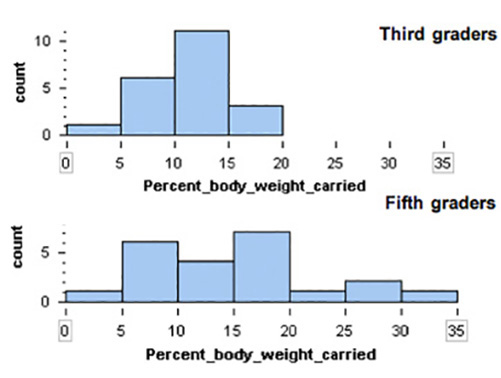
Percent of Body Weight Carried % of body weight carried in backpack Third
gradersFifth
graders0-5% 1 1 5-10% 6 6 10-15% 11 4 15-20% 3 7 20-25% 0 1 25-30% 0 2 30-35% 0 1 Totals 21 22 Note: Left-hand end-points are included in each bin. So the 2nd bin contains students carrying 5% of their body weight.
Module 7 Discussion Board
Use the Module 7 (opens in a new tab) to ask questions or provide feedback about the problems in any Module 7 activity – including this peer-reviewed assignment.
Review Feedback
- Instructor feedback is only available after an assignment is graded.
- Use these (opens in a new tab) to learn how to review feedback.
Click the “Next” or > button to continue.
Content by Cuyamaca College math faculty and licensed under the .
Rubric
Formative Assessments
Formative Assessments
Criteria Ratings Pts This criterion is linked to a Learning OutcomeAnswering the Prompt
10 pts
Total Points: 10
Requirements: 7 h
-
re 194 db 3 arkan
Unit 3: Real Estate Rights and Ownership
Title: Exploring Property Rights and Ownership Types
Instructions:
Real estate ownership includes a bundle of rights and different ownership types. Lets explore how they impact value and decision-making.In your post, include:
- Which ownership type (e.g., tenancy in common, joint tenancy) do you think is the best option for most people? Why?
- What do you think is the most important right in the “bundle of rights” (e.g., right to exclude, right to transfer)? Why?
Engagement:
Reply to at one or two classmates. Compare their choices to yours and share how these rights could influence real-world decisions.Unit Outline
I. Overview
II. Basic Concepts
A. What Is a Real Estate Appraisal?
- Definition: The act or process of developing an opinion of value for a property based on market data and professional judgment.
B. Real Estate and Real Property
- Real estate refers to the land itself and all things permanently attached to it.
1. Land
- Mineral rights Ownership rights to underground minerals such as oil, gas, or coal.
- Water rights Rights to use surface or underground water sources.
- Air rights Rights to the airspace above a property.
- Improved land When land is developed with structures or utilities, it becomes a site.
2. Fixtures
- Items affixed to land that are considered real property.
- Five tests for determining a fixture (MARIA):
- Method of attachment
- Adaptability of the item for the lands ordinary use
- Relationship of the parties
- Intention of the person placing the item on the land
- Agreement of the parties
3. Trade Fixtures
- Items installed by a tenant for business use (e.g., display cases, restaurant equipment).
- Unlike regular fixtures, trade fixtures remain personal property and must be removed by the tenant when vacating.
4. Bundle of Rights
- Definition: The rights of ownership of real property, including:
- The right to use the property.
- The right to sell or lease the property.
- The right to exclude others.
- The right to transfer ownership.
5. Public Restrictions on Land Use (Government Powers)
- Taxation Property taxes fund schools, roads, and public services.
- Eminent domain The government can seize private property for public use with compensation.
- Escheat If a property owner dies without heirs, the property reverts to the state.
- Police power Government authority to enforce zoning, health, and safety regulations.
6. Private Restrictions
- CC&Rs (Covenants, Conditions, and Restrictions): Rules set by a homeowners association (HOA) or developer that regulate property use.
Exercise 3-1
III. Legal Descriptions of Land
Appraisers use legal descriptions to accurately define property boundaries.
A. Lot and Block System
- Also called subdivision system or recorded plat system.
- Uses a subdivision map to define lot boundaries.
- Commonly used for residential and commercial properties.
Example: “Lot 5, Block 2, Lakeside Subdivision, City of San Diego, County of San Diego, State of California.”
B. Metes and Bounds System
- Definition: Uses physical landmarks and measurements to define property boundaries.
- Key terms:
- Point of Beginning (POB): The starting point of the property description.
- Metes: Measured distances.
- Bounds: Natural or artificial boundaries (e.g., trees, fences, rivers).
- Monuments: Fixed markers (e.g., iron rods, stone markers).
C. Rectangular Survey System
- Also called the Section and Township System or U.S. Government Survey System.
- Used for large tracts of land, especially in rural areas.
- Key terms:
- Townships: 36-square-mile areas, divided into 36 sections.
- Base Lines: Run east to west.
- Principal Meridians: Run north to south.
- Range Lines: Vertical lines that define townships.
- Sections: 1-mile-square parcels, containing 640 acres each.
Exercise 3-2
IV. Legal Rights and Interests
A. Freehold Estates (Ownership Rights)
- Fee Simple Estate The highest or most complete form of ownership.
- Fee Simple Absolute: No restrictions, inheritable.
- Fee Simple Defeasible: Subject to conditions (e.g., “must remain a park”).
- Life Estate Ownership lasts for the lifetime of an individual.
B. Nonfreehold Estates (Leasehold Interests)
- Leasehold Estate A tenant’s rights to occupy a property for a fixed term.
- Leased Fee Estate The landlord’s interest in a leased property.
Exercise 3-3
V. Other Interests in Real Estate
A. Easements
- A right to use another persons property for a specific purpose (e.g., driveways, utility lines).
B. License
- A temporary permission to use land (e.g., hunting, parking).
C. Encroachment
- Unauthorized intrusion onto anothers property (e.g., a fence built across a property line).
Example: A neighbors garage extends two feet into your property.
VI. Forms of Property Ownership
A. Individual Ownership
- Also called “ownership in severalty” (one person owns the property).
B. Co-Ownership (Concurrent Ownership)
- Tenancy in Common (TIC) Each owner holds an undivided interest, but shares dont have to be equal.
- Joint Tenancy Includes right of survivorship (if one owner dies, their share passes to the surviving owners).
- Community Property Used in some states where spouses own property equally.
- Tenancy by the Entirety Special form of joint ownership for married couples.
Exercise 3-4
VII. Business and Trust Ownership of Real Estate
A. Corporate Ownership
- A corporation owns the property, and shareholders own stock in the company.
B. Limited Liability Company (LLC)
- Provides the liability protection of a corporation but allows profits to be taxed like a partnership.
C. Trusts
- Land Trusts The trustee holds legal title, but the beneficiary controls the property.
- Living Trusts Created during a persons lifetime to manage assets.
D. Special Forms of Ownership
- Condominium Individual ownership of a unit with shared ownership of common areas.
- Cooperative (Co-Op) Residents own shares in a corporation that owns the building.
- Planned Unit Development (PUD) A mix of residential and commercial properties with shared amenities.
Exercise 3-5
Summary
This unit covered the fundamentals of real estate and ownership, including:
- Different types of legal descriptions.
- Forms of property ownership and interests.
- How public and private restrictions impact real estate.
Requirements: 1h
-
Response 3 p
For this assigment I attached 2 seperate discussion posts files. Can you respond to them separately? At least 10 sentences each with a reference. No chat gpt or ai please, and instead of being in agreeance with the response, deepen the discussion, or just elaborate on the topic. Thanks. -
Response 3 hp
For this assigment I attached 2 seperate discussion posts files. Can you respond to them separately? At least 10 sentences each with a reference. No chat gpt or ai please, and instead of being in agreeance with the response, deepen the discussion, or just elaborate on the topic. Thanks. -
Alterations of Thyroid Function
. Locate a current (medical or scientific) news or journal article based on one of the topics listed below:
- Alterations of Thyroid Function
Note: As you read through the article, think about how it connects to Pathophysiology and why is it relevant.
2. Provide a write-up summarizing the article. Within your document, include how the information connects to Pathophysiology, and why it is relevant.
3. Aim to include 150 – 200 words in the summary.
4. Remember to cite your source(s) in APA Format!
5. MS Word is the only acceptable document for credit. PDF and all other formats submitted will not be graded and will result in a 0 grade.
-
Main algebraic Sikha dunga
Requirements: