Category: Statistics

  • Statistics Question

    Required Resources

    Read/review the following resources for this activity:

    • : Chapters 2, 6, and 7
    • Week 5 Lesson

    Download the following documents for this activity.

    Instructions

    This week’s lab highlights using graphics, distributions, and tables to summarize and interpret data. Review the video below to gain an overview of this week’s lab assignment.

    1. Begin with 10 heights provided to you by your instructor. (Please see the link in the Required Resources above.)
    2. To add 10 more values to your lab data, survey or measure 10 people to find their heights.Add these heights to the Week 5 Lab Template along with the 10 provided by your instructor.
    3. Determine the mean and standard deviation forthe 20 values (your instructor’s 10 from Step 1A above plus your 10) by using theWeek 3 Excel Spreadsheet.
    4. Post a screenshot of the portion of the spreadsheet that helped you determine these values.
    5. How does your height compare to the mean (average) height of the20values? Is your height taller, shorter, or the same as the mean of the sample?

    Note: The values in the picture above are NOT the values that you are to use in your lab.

    Give some background information on the group of people you used in your study. Use the following questions to guide your answers.

    1. How did you choose the participants for your study? What was the sampling method:systematic, convenience, cluster, stratified, simple random?
    2. What part of the country did your study take place in?
    3. What are the age ranges of your participants?
    4. How many of each gender did you have in your study?
    5. Identify the population based on the sample gathered. For example, if you sampled people that worked on your floor in the hospital, your population may be all employees at your hospital or if you sampled your neighbors, maybe the population is everyone who lives in your city.
    6. Use the Week 5 Excel Spreadsheetfor the following:
      1. Use theEmpirical Ruletab from the spreadsheet. Then, determine the 68%, 95%, and 99.7% values of the Empirical Rule in terms of the20 heightsin your height study.
      2. Post a screenshot of your work from the Week 5 Excel spreadsheet.

      Screenshot of Week 5 Excel spreadsheet for lab-1.png

      1. What do these values tell you? (Example: These values tell me that 68% of the heights in the [name your study population; where did you draw your data from?] will fall between 62.584 inches and 70.916 inches. 95% will…).
      2. Post another screenshot of your work from the Normal Probability tab from the Week 5 Excel spreadsheet. Normal Probability Tab screenshot.png
      3. Based on your study results, what percent of the study participants are shorter than you? What percent are taller than you? (Example:If my height is 73 inches, then 20.86% of the relevant population is shorter. The other 79.14%, of course, is taller).

      GradingThis activity will be graded based on the Week 5 Lab Assignment Rubric.

      Outcomes

      • CO 6: Interpret the principles of normally distributed data sets.
      • CO 7: Evaluate the probability using the Normal Distribution.

      Due Date

      By 11:59 p.m. MT on Sunday

      Rubric

      Week 5 Lab Assignment Rubric (1)

      Week 5 Lab Assignment Rubric (1)
      Criteria Ratings Pts
      This criterion is linked to a Learning OutcomeMeasures of Central Tendency and Variation 12 ptsAddresses all elements of the following: 1). 20 height values; 2). mean of data; 3). standard deviation of data; 4). screenshot of values calculated on spreadsheet; 5). comparison of heights10 ptsAddresses 4 out of 5 of the following: 1). 20 height values; 2). mean of data; 3). standard deviation of data; 4). screenshot of values calculated on spreadsheet; 5). comparison of heights8 ptsAddresses 3 out of 5 of the following: 1). 20 height values; 2). mean of data; 3). standard deviation of data; 4). screenshot of values calculated on spreadsheet; 5). comparison of heights7 ptsAddresses 1 or 2 out of 5 of the following: 1). 20 height values; 2). mean of data; 3). standard deviation of data; 4). screenshot of values calculated on spreadsheet; 5). comparison of heights0 ptsNo Effort 12 pts
      This criterion is linked to a Learning OutcomePopulation Data and Sampling Techniques 15 ptsAddresses all elements of the following: 1). Sampling method; 2). Location; 3). Age group of participants; 4). Gender of participants; 5). Identify the population based on the sample gathered13 ptsAddresses 4 out of 5 of the following: 1). Sampling method; 2). Location; 3). Age group of participants; 4). Gender of participants; 5). Identify the population based on the sample gathered11 ptsAddresses 3 out of 5 of the following: 1). Sampling method; 2). Location; 3). Age group of participants; 4). Gender of participants; 5). Identify the population based on the sample gathered9 ptsAddresses 1 or 2 out of 5 of the following: 1). Sampling method; 2). Location; 3). Age group of participants; 4). Gender of participants; 5). Identify the population based on the sample gathered0 ptsNo Effort 15 pts
      This criterion is linked to a Learning OutcomeProbability, and Measures that would follow a normal distribution in life sciences 15 ptsAddresses all elements of the following: 1). Empirical Rule values; 2). Interpretation of Empirical Rule values; 3). Screenshot of Empirical spreadsheet; 4). Interpretation of Normal Distribution spreadsheet values; 5). Screenshot of probabilities/ percentiles13 ptsAddresses 4 out of 5 of the following: 1). Empirical Rule values; 2). Interpretation of Empirical Rule values; 3). Screenshot of Empirical spreadsheet; 4). Interpretation of Normal Distribution spreadsheet values; 5). Screenshot of probabilities/ percentiles11 ptsAddresses 3 out of 5 of the following: 1). Empirical Rule values; 2). Interpretation of Empirical Rule values; 3). Screenshot of Empirical spreadsheet; 4). Interpretation of Normal Distribution spreadsheet values; 5). Screenshot of probabilities/ percentiles9 ptsAddresses 1 or 2 out of 5 of the following: 1). Empirical Rule values; 2). Interpretation of Empirical Rule values; 3). Screenshot of Empirical spreadsheet; 4). Interpretation of Normal Distribution spreadsheet values; 5). Screenshot of probabilities/ percentiles0 ptsNo Effort 15 pts
      This criterion is linked to a Learning OutcomeGrammar and Formatting 8 ptsLab is easy to read and presents material in a logical order with no grammatical errors.7 ptsLab is easy to read and presents material in a logical order. There are a few grammatical errors but they do not distract from readability.6 ptsLab is easy to read and has few grammatical errors, but it is not logically organized.5 ptsThere are significant grammatical errors and organizational issues that distract from readability.0 ptsNo Effort 8 pts

      50

  • OPUSWORKS black belt certification

    I have attached my “Black Belt Data (Tab 2-2a) which has all the data from the process improvement. I have to transfer it to the “Ticket-System-Data” document, explain the process using their formulas, a two to three page document with key take ways and transcribe it to the “MFR_Ticket_System_CAPSTONE” document as well.

    Completing this Capstone will fulfill the final requirements for your training. To successfully complete this process, please follow these three essential steps:

    1. Analyze and Summarize: Review the two attached documents (“MFR_ID-Card-Data-Analysis-Review_CAPSTONE_20260312.pdf” and “DATA_ID-Card-Customer-Data.xlsx”). Based on your analysis, create a one-page Executive Summary. The goal is to present your unique analytical insights, not just to reiterate the problem statement
    2. Draft a Reflection Document: Submit a two to three-page document that includes the following sections:
    • Impactful Learning Objectives: A summary of your key takeaways from the course and how they have shaped your thinking.
    • Practical Application: An explanation of how you plan to apply this knowledge in your role, or an example of a technique you have already implemented.
    • One-Year Goal: A professional goal that is aligned with the mission and objectives of your home unit

      should be three products Ticket-System-Data, MFR_Ticket_System_CAPSTONE and a two to three page document explaining the process (key takeways)

  • Statistics Question

    Assessment 4: Details and instructions

    Completion requirements

    Assessment 4

    Written assessment

    Word count/length

    2000 words equivalent

    SILOs

    • Comprehend the fundamental principles of epidemiology and biostatistics (SILO 1).
    • Explain how the principles of epidemiology and biostatistics can be applied in public health (SILO 2).
    • Explain, differentiate, and apply fundamental concepts of epidemiology and biostatistics (SILO 3).
    • Recognise, generate, interpret and communicate descriptive and basic inferential statistics (SILO 5).

    Graduate capabilities

    • DISCIPLINE KNOWLEDGE AND SKILLS
    • INQUIRY AND ANALYSIS – Critical Thinking and Problem Solving
    • INQUIRY AND ANALYSIS – Research and Evidence-Based Inquiry

    Generative AI use

    The applicable AI use category is: AI Planning

    You may use AI tools to:

    • revise or understand concepts
    • brainstorm ideas
    • structure/outline responses
    • clarify task requirements

    You should not use AI to analyse or interpret data, nor generate text for submission.

    As AI use is permitted in this assessment you are required to complete and submit an AI Acknowledgment after submitting your assessment.

    .

    Task details

    Prepare a written briefing document. Using the dataset provided, identify demographic, social and behavioural factors that are associated with routine check-up attendance.

    Assessment criteria

    This assessment will measure your ability to:

    • Write an effective summary that clearly articulates a key message (25%)
    • A summary of the design of the BRFSS, its limitations and a comparison with a peer-reviewed paper (10%)
    • Description of the population (20%)
    • Examination of the association between four social and/or behavioural factors and routine check-up attendance (40%)
    • Appropriately format and organise the written assignment (5%)

    Refer to the Rubric for marking and feedback information.

    Instructions

    Scenario:

    A generation ago, people used to see their doctor only when they were sick or dying. Today, preventative health care is becoming commonplace as people become more educated and empowered about their own health. Regular, routine medical check-ups can help find potential health issues before they become a problem. Early detection of problems gives the best chance for getting the right treatment quickly, avoiding any complications.

    You have been employed as part of an active public health campaign that is aiming to increase routine 12-monthly check-ups. Your job is to analyse a subset of variables (as indicated below) and describe the association between these variables and routine check-up attendance and highlight the people with lower rates of check-ups in the last 12 months where a targeted campaign would be of most benefit.

    The Behavioral Risk Factor Surveillance System (BRFSS) is a collaborative project between all of the states in the United States (US) and participating US territories and the Centers for Disease Control and Prevention (CDC). The BRFSS is a system of ongoing health-related telephone surveys designed to collect data on health-related risk behaviours, chronic health conditions and use of preventive services from the non-institutionalised adult population (18 years) residing in the United States. Using the prepared BRFSS data, identify demographic, social and behavioural factors that are associated with routine check- up attendance.

    Dataset: The data set is updated each time the subject runs. You can access the relevant file on the main assessment page under Assignment 4.

    Format:

    Your written briefing document must consist of a 250-word executive summary and a detailed structured results section. This template will assist you with the format and information required.

    Executive Summary (Marks: 25)

    The 250-word summary should identify demographic, social and behavioural factors that are associated with routine check-up attendance in a statistically valid, clear and concise manner that can be understood by someone with minimal knowledge of epidemiology and biostatistics. You must identify a group or groups of people where a targeted campaign would be of most benefit.

    Results:

    The BRFSS:

    • A short summary of the study design of the BRFSS and a brief discussion of its limitations (no more than 250 words (Marks: 6)
    • Find a peer-reviewed paper in the literature that quantitatively investigates the determinants of routine check-up attendance. Compare the designs between the study described in that paper and BRFSS (not more than 150 words). (Marks: 4) (Note: When you search for a peer-reviewed paper, avoid literature reviews or papers that analysed BRFSS data)

    Description of the population and analysis (no more than 1350 words):

    1) By analysing the BRFSS dataset, answer the following questions:

    • In your dataset, what percentage of participants reported routine check-up attendance? (Marks: 5)
    • Create a table of routine check-up attendance and 3 demographic factors, one of which must be binary, one numerical and one multi-category categorical (either nominal or ordinal). (Marks: 15)
      • Each cell should contain the appropriate summary measure and 95% confidence interval
      • The final column in the table should contain the p-value for statistical tests of difference or independence (i.e., tests that we covered in week 6). Footnotes should be used to indicate which statistical tests were used.

    2) Examine the association between 4 social and/or behavioural factors and routine check-up attendance:

    • In an appropriate manner, present the results of analysis into the effect of four social and/or behavioural factors on routine check-up attendance. You must analyse a binary, numeric, nominal and ordinal factor. (Marks: 20)
      • For each factor you should report:
        • Variable name and data type
        • Name of measure calculated
        • Results of statistical analysis performed
        • Statistical interpretation
        • The Stata output (including visible code) e.g.

    Figure 1
    Stata output example

    • For one of the identified factors, you should explore the possibility of confounding or effect modification by sex. (Marks: 10)
      • Perform appropriate analysis
      • Present STATA output (including visible code if applicable)
      • Report the results in a table
      • Interpret your result
    • Conduct a multivariable regression and present the results, including visible Stata output, of the adjusted regression model by including the four factors you examined in your analysis of social and behavioural factors. (Marks: 10)
      • Report the results in a table.
      • Interpret your result.

    Resources and readings relevant for assessment

    • The data file can be found on the main Assessment page under Assessment 4.
    • The Behavioral Risk Factor Surveillance System (BRFSS)
    • Assessment 4 template
  • Mathematical Statistics Exponential Distribution (MLE, Fish…

    I need a complete, detailed, step-by-step solution to the attached mathematical statistics problem.

    Please follow these instructions carefully:

    • Show all steps clearly and logically (no skipping steps)
    • Use proper mathematical notation and clear explanations
    • Justify each result using correct statistical concepts (MLE, sufficiency, Fisher information, CRLB, UMVUE, etc.)
    • Clearly highlight final answers for each part
    • Keep the work neat, organized, and easy to follow
    • Avoid unnecessary shortcuts I need full understanding of the process

    The solution should be written in a clear academic style, suitable for submission.

    Thank you.

  • Factors Associated with Routine Medical Check-Up Attendance:…

    Assessment 4: Details and instructions

    Completion requirements

    Assessment 4
    Written assessment
    Word count/length 2000 words equivalent
    SILOs
    • Comprehend the fundamental principles of epidemiology and biostatistics (SILO 1).
    • Explain how the principles of epidemiology and biostatistics can be applied in public health (SILO 2).
    • Explain, differentiate, and apply fundamental concepts of epidemiology and biostatistics (SILO 3).
    • Recognise, generate, interpret and communicate descriptive and basic inferential statistics (SILO 5).
    Graduate capabilities
    • DISCIPLINE KNOWLEDGE AND SKILLS
    • INQUIRY AND ANALYSIS – Critical Thinking and Problem Solving
    • INQUIRY AND ANALYSIS – Research and Evidence-Based Inquiry
    Generative AI use

    The applicable AI use category is: AI Planning

    You may use AI tools to:

    • revise or understand concepts
    • brainstorm ideas
    • structure/outline responses
    • clarify task requirements

    You should not use AI to analyse or interpret data, nor generate text for submission.

    As AI use is permitted in this assessment you are required to complete and submit an AI Acknowledgment after submitting your assessment.

    .

    Task details

    Prepare a written briefing document. Using the dataset provided, identify demographic, social and behavioural factors that are associated with routine check-up attendance.

    Assessment criteria

    This assessment will measure your ability to:

    • Write an effective summary that clearly articulates a key message (25%)
    • A summary of the design of the BRFSS, its limitations and a comparison with a peer-reviewed paper (10%)
    • Description of the population (20%)
    • Examination of the association between four social and/or behavioural factors and routine check-up attendance (40%)
    • Appropriately format and organise the written assignment (5%)

    Refer to the Rubric for marking and feedback information.

    Instructions

    Scenario:

    A generation ago, people used to see their doctor only when they were sick or dying. Today, preventative health care is becoming commonplace as people become more educated and empowered about their own health. Regular, routine medical check-ups can help find potential health issues before they become a problem. Early detection of problems gives the best chance for getting the right treatment quickly, avoiding any complications.

    You have been employed as part of an active public health campaign that is aiming to increase routine 12-monthly check-ups. Your job is to analyse a subset of variables (as indicated below) and describe the association between these variables and routine check-up attendance and highlight the people with lower rates of check-ups in the last 12 months where a targeted campaign would be of most benefit.

    The Behavioral Risk Factor Surveillance System (BRFSS) is a collaborative project between all of the states in the United States (US) and participating US territories and the Centers for Disease Control and Prevention (CDC). The BRFSS is a system of ongoing health-related telephone surveys designed to collect data on health-related risk behaviours, chronic health conditions and use of preventive services from the non-institutionalised adult population (18 years) residing in the United States. Using the prepared BRFSS data, identify demographic, social and behavioural factors that are associated with routine check- up attendance.

    Dataset: The data set is updated each time the subject runs. You can access the relevant file on the main assessment page under Assignment 4.

    Format:

    Your written briefing document must consist of a 250-word executive summary and a detailed structured results section. This template will assist you with the format and information required.

    Executive Summary (Marks: 25)

    The 250-word summary should identify demographic, social and behavioural factors that are associated with routine check-up attendance in a statistically valid, clear and concise manner that can be understood by someone with minimal knowledge of epidemiology and biostatistics. You must identify a group or groups of people where a targeted campaign would be of most benefit.

    Results:

    The BRFSS:

    • A short summary of the study design of the BRFSS and a brief discussion of its limitations (no more than 250 words (Marks: 6)
    • Find a peer-reviewed paper in the literature that quantitatively investigates the determinants of routine check-up attendance. Compare the designs between the study described in that paper and BRFSS (not more than 150 words). (Marks: 4) (Note: When you search for a peer-reviewed paper, avoid literature reviews or papers that analysed BRFSS data)

    Description of the population and analysis (no more than 1350 words):

    1) By analysing the BRFSS dataset, answer the following questions:

    • In your dataset, what percentage of participants reported routine check-up attendance? (Marks: 5)
    • Create a table of routine check-up attendance and 3 demographic factors, one of which must be binary, one numerical and one multi-category categorical (either nominal or ordinal). (Marks: 15)
      • Each cell should contain the appropriate summary measure and 95% confidence interval
      • The final column in the table should contain the p-value for statistical tests of difference or independence (i.e., tests that we covered in week 6). Footnotes should be used to indicate which statistical tests were used.

    2) Examine the association between 4 social and/or behavioural factors and routine check-up attendance:

    • In an appropriate manner, present the results of analysis into the effect of four social and/or behavioural factors on routine check-up attendance. You must analyse a binary, numeric, nominal and ordinal factor. (Marks: 20)
      • For each factor you should report:
        • Variable name and data type
        • Name of measure calculated
        • Results of statistical analysis performed
        • Statistical interpretation
        • The Stata output (including visible code) e.g.
    Figure 1
    Stata output example

    • For one of the identified factors, you should explore the possibility of confounding or effect modification by sex. (Marks: 10)
      • Perform appropriate analysis
      • Present STATA output (including visible code if applicable)
      • Report the results in a table
      • Interpret your result
    • Conduct a multivariable regression and present the results, including visible Stata output, of the adjusted regression model by including the four factors you examined in your analysis of social and behavioural factors. (Marks: 10)
      • Report the results in a table.
      • Interpret your result.

    Resources and readings relevant for assessment

    • The data file can be found on the main Assessment page under Assessment 4.
    • The Behavioral Risk Factor Surveillance System (BRFSS)
    • Assessment 4 template
  • Hi pleas I need help for my homework

    Progress Check

    Use this activity to assess whether you and your peers can:

    • Use StatCrunch to conduct a hypothesis test to test a claim about a population mean.
    • State an appropriate conclusion in context.
    • Explain the meaning of each relevant item from the StatCrunch output.

    Directions

    Use the drop-down menu to learn about the three steps needed to complete this assignment.

    Three steps to complete the assignment

    Context

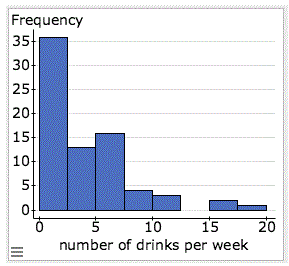
    A group of 75 college students from a liberal arts college were randomly sampled and asked about the number of alcoholic drinks they have in a typical week. The file containing the data is linked below. The purpose of this was to compare the drinking habits of the students at the college to the drinking habits of college students in general. In particular, the dean of students, who initiated this study, would like to check whether the mean number of alcoholic drinks that students at his college have in a typical week differs from the mean of U.S. college students in general, which is estimated to be 4.73.


    Variables

    The number of alcoholic beverages a student consumes in a week.


    Data

    Open the drinks datafile in the Stats at Cuyamaca College group on StatCrunch ( – opens in a new tab).

    Note – the drinks datafile is different from the college_drinking file.


    Prompt

    The drinks datafile is available in the Data section above.

    1. Let be the mean number of alcoholic beverages that students in the liberal arts college drink in a typical week. State the hypotheses.
    2. Here is a histogram of the data. Can we safely use the t-test with this data? Explain.
      Histogram: strong peak on the left, no left tail, long right tail
    3. Perform the t-test using StatCrunch. ()
      Copy and paste the information from the StatCrunch output window into the textbox.
    4. Based on the P-value, state your conclusions in context. Use a 5% level of significance.
      NOTE: You do not need to double the P-value for this two-tailed test. StatCrunch calculates the P-value for you.
    5. Using the context of this scenario, explain the meaning of each of following items from the StatCrunch output for the hypothesis test.
      1. Std. Err (standard error)
      2. T-stat (T-score)
      3. P-value

    List of StatCrunch Directions

    Click here for StatCrunch Directions

    Module 22 Discussion Board

    Use the Module 22 (opens in a new tab) to ask questions or provide feedback about the problems in any Module 22 activity – including this peer-reviewed assignment.


    Review Feedback

    • Instructor feedback is only available after an assignment is graded.
    • Use these (opens in a new tab) to learn how to review feedback.

    Click the “Next” or > button to continue.

    Content by Cuyamaca College math faculty and licensed under the .

    Rubric

    Formative Assessments w/ StatCrunch

    Formative Assessments w/ StatCrunch

    Criteria Ratings Pts

    This criterion is linked to a Learning OutcomeAnswering the Prompt

    8 ptsFull CreditThe first submission demonstrates a good-faith effort to address each part of the Prompt. Either in the first draft or the optional final draft, all parts of the “Prompt” are addressed and the responses demonstrate attainment of the learning objectives in the “Progress Check” section of the assignment. The answers are correct. The writing/work is clear. The explanation/work is reasonable, well-organized, and easy to follow.6.5 ptsMostly CorrectThe first submission demonstrates a good-faith effort to address most of the Prompt. In the optional final draft all parts of the “Prompt” are addressed, and the responses demonstrate attainment of the learning objectives in the “Progress Check” section of the assignment. The answers are mostly correct. The writing/work is clear. The explanation/work is reasonable, well-organized, and easy to follow.

    3.5 ptsOne or more incorrectThe first submission demonstrates a good-faith effort to respond to a smaller portion of the Prompt. In the first draft or the optional final draft, one or more parts of the “Prompt” are not addressed or are incorrect. Or, answers do not demonstrate attainment of the learning objectives in the “Progress Check” section of the assignment. Or, answers are correct, but the writing/work is unclear, incorrect, or difficult to follow.0 ptsNo MarksThe first submission does not demonstrate a good-faith effort to address the Prompt.

    8 pts

    This criterion is linked to a Learning OutcomeStatCrunch

    2 ptsFull CreditStatCrunch graphs and/or tables are correct and embedded with your work.1 ptsPartial CreditStatCrunch graphs and/or tables are incorrect or missing important information.

    0 ptsNo CreditNo StatCrunch information is embedded with your post. Or all StatCrunch work is incorrect.

    2 pts

    Total Points: 10

  • Hi pleas I need help for my homwork

    Progress Check

    Use this activity to assess whether you and your peers can:

    • Use StatCrunch to find a one-sample T-interval to estimate a population mean.
    • Interpret a confidence interval in context.
    • Use a confidence interval to find the margin of error (MOE).
    • Identify which of the two confidence intervals is more accurate.
    • Identify which of the two confidence intervals is more precise.

    Directions

    Use the drop-down menu to learn about the three steps needed to complete this assignment.

    Three steps to complete the assignment

    Step 1: Review the Rubric

    • Before you submit your work, review the rubric at the bottom of this assignment.
    • Use the rubric as a checklist to determine whether you are ready to submit your work.

    Step 2: First Draft

    • Commit a good-faith effort to address each item in the Prompt section below.
    • Please be sure to number your responses and include “white space” between problem numbers. This improves the readability and flow of your work. I cannot give feedback and grade jumbled work.
    • Use either of the following options to submit your work.
      OPTION 1: You can submit a text-entry assignment (i.e. typing your answers in Canvas). To learn how to submit a text-entry assignment, use these (opens in a new tab).
      OPTION 2: You can upload your paper-and-pencil work (or the digital equivalent). To learn how to upload your paper-and-pencil work, use these (opens in a new tab). WARNING – some file types may not be visible on my end. So to learn which files you can upload, be sure to use the directions link I provided for this option.
    • Not ready to submit a good-faith effort yet? Avoid frustration – use the link to the Questions, Answers, & Tips discussion board (at the bottom of this page) to post questions about this assignment (or visit the discussion board to answer your classmates’ questions). You can also contact me directly (see the homepage for my contact information).

    Step 3: Optional Final Draft

    • After you submit your good-faith attempt to fully respond to the questions in the Prompt section below, advance to the ANSWER(S) page.
    • You can use the ANSWER(S) page to correct your work and resubmit this assignment any time before I begin grading the problems. However, to earn full credit, you are not required to submit a final draft for this assignment. But if you do submit a final draft, I will only grade it if you submitted a good-faith effort on your first draft.
    • Warning – I will only grade your most recent submission. So if you choose to submit a final draft, please do not leave anything out, and please do not direct me to read an earlier submission. To maximize your score, your most recent submission (at the time I begin grading) must be complete.

    Data

    All directions in this assignment open in a new tab.

    • Login and open StatCrunch ().
    • Open your IAT sample data set in StatCrunch ().

    Variables

    Gender-Career IAT Variables

    Gender-Career IAT (opens in a new tab).

    Gender-Science IAT Variables

    Gender-Science IAT (opens in a new tab).

    Race IAT Variables

    Race IAT (opens in a new tab).

    Sexuality IAT Variables

    Sexuality IAT (opens in a new tab).

    Weapons IAT Variables

    Weapons IAT (opens in a new tab).

    Weight IAT Variables

    Weight IAT (opens in a new tab).


    Prompt

    You are tasked with using StatCrunch and your unique IAT sample to estimate the population mean for your IAT-Score variable.

    Question 1

    1. Use StatCrunch and your unique IAT sample to estimate the mean IAT-Score for the population of IAT participants at the 80% confidence level (). Copy the contents of your StatCrunch output window and paste it into your response.
    2. Identify the 80% confidence interval.
    3. Interpret your confidence interval in context.
    4. Can we use the StatCrunch output to find the margin of error (MOE)? If so, what is the MOE? If not, identify the missing information.

    Question 2

    1. Use StatCrunch and your unique IAT sample to estimate the mean IAT-Score for the population of IAT participants at the 95% confidence level (). Copy the contents of your StatCrunch output window and paste it into your response.
    2. Identify the 95% confidence interval.
    3. Interpret your confidence interval in context.
    4. Can we use the StatCrunch output to find the margin of error (MOE)? If so, what is the MOE? If not, identify the missing information.

    Question 3

    1. Which of the two confidence intervals is more accurate? Briefly explain.
    2. Which of the two confidence intervals is more precise? Briefly explain.

    StatCrunch Directions

    Here is a PDF document with all (opens in a new tab).


    Module 21 Discussion Board

    Use the Module 21 (opens in a new tab) to ask questions or provide feedback about the problems in any Module 21 activity – including this peer-reviewed assignment.


    Review Feedback

    • Instructor feedback is only available after an assignment is graded.
    • Use these (opens in a new tab) to learn how to review feedback.

    Click the “Next” or > button to continue.

    Content by Cuyamaca College math faculty and licensed under the .

    Rubric

    Formative Assessments w/ StatCrunch

    Formative Assessments w/ StatCrunch

    Criteria Ratings Pts

    This criterion is linked to a Learning OutcomeAnswering the Prompt

    8 ptsFull CreditThe first submission demonstrates a good-faith effort to address each part of the Prompt. Either in the first draft or the optional final draft, all parts of the “Prompt” are addressed and the responses demonstrate attainment of the learning objectives in the “Progress Check” section of the assignment. The answers are correct. The writing/work is clear. The explanation/work is reasonable, well-organized, and easy to follow.6.5 ptsMostly CorrectThe first submission demonstrates a good-faith effort to address most of the Prompt. In the optional final draft all parts of the “Prompt” are addressed, and the responses demonstrate attainment of the learning objectives in the “Progress Check” section of the assignment. The answers are mostly correct. The writing/work is clear. The explanation/work is reasonable, well-organized, and easy to follow.

    3.5 ptsOne or more incorrectThe first submission demonstrates a good-faith effort to respond to a smaller portion of the Prompt. In the first draft or the optional final draft, one or more parts of the “Prompt” are not addressed or are incorrect. Or, answers do not demonstrate attainment of the learning objectives in the “Progress Check” section of the assignment. Or, answers are correct, but the writing/work is unclear, incorrect, or difficult to follow.0 ptsNo MarksThe first submission does not demonstrate a good-faith effort to address the Prompt.

    8 pts

    This criterion is linked to a Learning OutcomeStatCrunch

    2 ptsFull CreditStatCrunch graphs and/or tables are correct and embedded with your work.1 ptsPartial CreditStatCrunch graphs and/or tables are incorrect or missing important information.

    0 ptsNo CreditNo StatCrunch information is embedded with your post. Or all StatCrunch work is incorrect.

    2 pts

    Total Points: 10

  • Statistics Question

    Assessment (Post Test)

    1. Which of the following refers to the hypothesis of no differences, usually formulated to express purpose of rejection?

    Alternative hypothesis

    Error Hypothesis

    Null Hypothesis

    Significance Hypothesis

    2. Which of the following refers to the operational statement of the researcher’s hypothesis is the one that hopes to accept.

    Alternative hypothesis

    Error Hypothesis

    Null Hypothesis

    Significance Hypothesis

    3. Which of the following refers to the alternative hypothesis that utilizes the symbol.

    Directional

    Non-Directional

    One -tailed test

    Two-tailed test

    4. Which of the following refers to the alternative hypothesis that utilizes the < or the symbol?

    Directional

    Non-Directional

    One -tailed test

    Two-tailed test

    5. It is the area where a very small probability is attained such that the values in this area have a very slim chance of occurring in any sample

    A. Critical Region

    C. Non- Rejection Region

    B. Critical Value

    D. Statistical Region

    6. Suppose the null hypothesis is rejected, the probability of the Type I error will be 10%. What is the probability of a correct decision?

    A.90%

    B. 95%

    C. 99%

    D. 100%

    7. A medical trial is conducted in Vicente Sotto Memorial Medical Center to test whether or not a new medicine reduces cholesterol by 35%. Which of the following statement describes the null hypothesis?

    Ho: The drug reduces cholesterol by 35%. p = 0.35.

    1. Ho : The drug reduces cholesterol by more than 35%. p > 0.35.
    2. Ho : The drug reduces cholesterol by less than 35%. p < 0.35
    3. Ho : The drug does not reduce cholesterol by less than 35%. p * 0.35.crot a cort come in 18 years old when, in fact, she is 16 years old. WheType I error B. Type Il error C. Type Ill erroD. Type IV error11. A man plans to go hunting the Philippine monkey-eating eagle believing that it is a proof of his mettle. What type of error is this?A. Type I error B. Type II errorC. Type III errorD. Type IV error12. Which of the following statement about types of error in hypothesis testing isINCORRECT?
      1. Ho is true and we decide not to reject it.
      2. Ho is false and we decide not to reject it.
      3. A Type I Error occurs when you reject the null hypothesis when it is actually true.
      4. A Type Il Error occurs when you do not reject the null hypothesis when it is actually false.

      For items 13-15, refer to the given problem below:A Grade 3 teacher wants to test ( at a = 0.05 ) whether the average body massindex (BMI) of the pupils under feeding program is different from 25.5 kg.13. What is the probability of committing type I error?A. 0.01B. 0.05C. 0.08D. 0.0514. What is the conclusion when Ho is rejected?

      1. The average BMI of the pupils under feeding program is different from 25.5 kg.
      2. The average BMI of the pupils under feeding program is equal from 25.5
      3. The average BMI of the pupils under feeding program is more than or greater from 25.5 kg.
      4. The average BMI of the pupils under feeding program is less than or greater from 25.5 kg.

      State the conclusion when Ho is not rejected.

    4. A. The average BMI of the pupils under feeding program is 25.5.The average BMI of the pupils under feeding program is less than 25.
    5. The average BMI of the pupils under feeding program is greater the2. The average BMI of the pupils under feeding program is not equal 25,5.
  • Mean: Add all values in the dataset, then divide by the number of values.
  • Median: Arrange the values in order, then find the middle value (or average the two middle values if even count).
  • Standard deviation:
    1. Find the mean
    2. Subtract the mean from each value (get deviations)
    3. Square each deviation
    4. Find the average of those squares (variance)
    5. Take the square root of the variance